
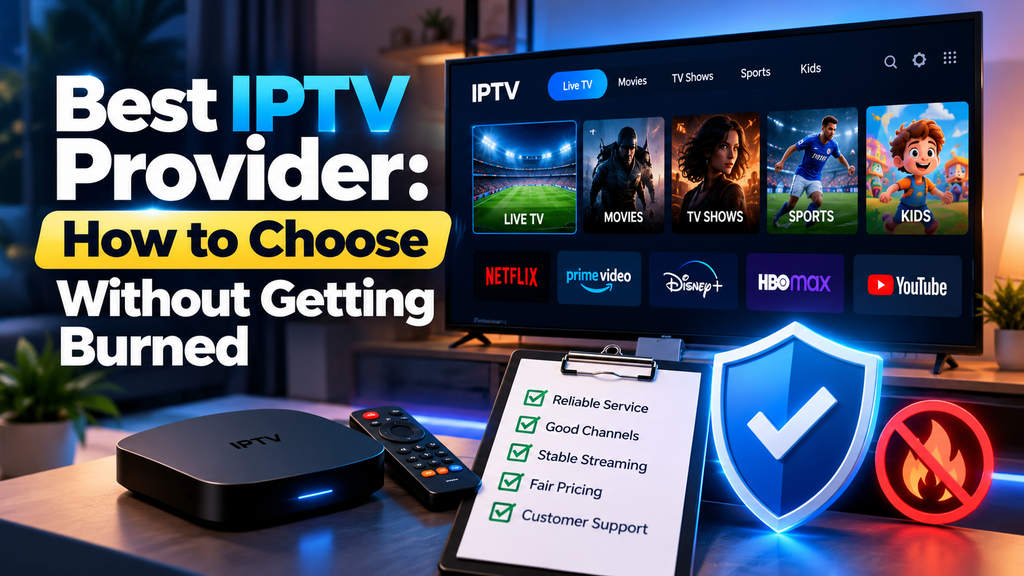
Best IPTV Provider Worldwide
Key Takeaways
- The best IPTV provider is defined by server reliability, verified channel lists, and honest pricing, not subscriber counts or marketing claims
- Always test with a free trial during peak viewing hours, not a quiet weekday afternoon
- Channel count means nothing if the channels you actually watch are buffering or missing
- Live customer support with sub-30-minute response times is the baseline, not a premium feature
- Pricing should be clear upfront: multi-connection costs, renewal rates, and refund policy all stated before checkout
- Samflix offers redundant servers, verified EPG data, and 24/7 live support as standard
- Walk away from any provider that cannot confirm specific channels, refuses a trial, or hides a refund policy
Choosing the best IPTV provider is not as simple as picking the one with the longest channel list. Providers make dramatic promises, deliver shaky streams, and go quiet when you need support. This guide cuts through the noise and gives you a tested, experience-based framework for evaluating any IPTV service before you hand over your money.
Why Most IPTV Comparisons Miss the Point
Most review sites rank the best IPTV provider by channel count. That is the wrong metric. A provider advertising 40,000 channels may be counting dead feeds, duplicate resolutions, and foreign-language streams you will never use. What actually determines your experience is server stability during the events you care about, not the total number of feeds sitting in a database.
When choosing the best IPTV provider, the real variables are server infrastructure, panel management, and content sourcing. A smaller provider with serious infrastructure will outperform a large one running on shared, oversold servers every single time. Channel count is easy to inflate. Server reliability is not.
What the Best IPTV Provider Actually Delivers
Four things the best IPTV provider must get right. Miss any one of them and the whole experience falls apart.
Consistent Server Uptime
Uptime is the foundation. If servers cannot handle concurrent load during a major sporting event or a season finale, nothing else matters. Good providers run redundant server clusters, meaning a backup kicks in automatically if one node struggles. Ask any provider directly: “What is your server redundancy setup?” If they cannot answer that, assume there is no redundancy.
Consistency matters more than any single impressive trial day. The best IPTV provider performs well week after week, not just during initial evaluation periods. Test across multiple sessions before committing to an annual plan.
Verified Channel Lists
Channel counts are frequently inflated. A provider advertising 40,000 channels may be including dead channels, duplicate entries across different resolutions of the same feed, and channels from markets you will never watch. What matters is whether the specific channels you want are available, stable, and accurately labeled.
Before subscribing, ask for confirmation of specific channels in writing. If a provider cannot confirm that Sky Sports Main Event, ESPN, or your preferred regional sports network is included and reliable, that is a red flag regardless of their headline channel count. The best IPTV provider does not need to hide behind vague totals.
Responsive Customer Support
The best IPTV provider has support you can actually reach when something breaks. Live chat with sub-30-minute response times is the minimum acceptable standard. Test support during your trial period. Ask a technical question and see how quickly and accurately they respond. If trial-period support is slow, paid-subscriber support will be worse.
This is one of the most overlooked evaluation points. Most people test streams during a trial and ignore support entirely. Then a live match buffers out during the second half and nobody is available to help. Do not make that mistake.
Pricing Transparency
Pricing should be clear: one price for one package, with multi-connection costs and renewal terms stated upfront. Hidden fees at checkout, vague refund policies, and pricing that changes between the sales page and the invoice are all signs of a provider you do not want a long-term relationship with.
A legitimate provider will tell you exactly what you are getting, how much it costs at renewal, and what happens if you want a refund. If any of those three things require a support ticket to find out, keep looking.
How to Evaluate Any IPTV Provider Before Paying
Get a Trial and Use It Properly
Any best IPTV provider worth subscribing to will offer a free trial. 24 to 48 hours is standard. But a trial only tells you something useful if you test it correctly. Streaming on a quiet Tuesday at 2am proves very little about what peak-hour performance looks like from a best IPTV provider.
Test during peak hours: Saturday afternoon during a live match, or Sunday evening when most people are streaming simultaneously. That is when oversold servers buckle. Test the specific channels you actually use. Watch for ten full minutes during content you care about. Buffering that appears after three minutes is common on unstable servers and will not show up in a thirty-second spot-check.
Check Their EPG Accuracy
EPG stands for Electronic Programme Guide, the schedule data that tells you what is on and when. Good EPG data matters for catch-up content and scheduled recordings. If the EPG is showing wrong information or missing schedules, either their content sourcing is poor or their panel management is sloppy. Both are warning signs about the overall quality of the operation.
Find Recent Customer Feedback
Subreddits like r/IPTV and r/cordcutters are useful for finding unfiltered provider feedback. Look for recent posts, not year-old threads. IPTV provider quality can shift dramatically when ownership changes or infrastructure gets oversold. Feedback from the last 60 to 90 days gives you a far more accurate picture than older reviews that may no longer reflect the current service.
Ask About Multi-Connection Pricing
If you have more than one television or want to watch on a tablet while someone else watches on the main screen, you need to know the cost per connection upfront. Some providers charge per connection, others offer household packages. Neither model is wrong. But you should know before subscribing, not after the first invoice arrives.
Red Flags That Should End the Conversation
Some things are not warning signs when evaluating a best IPTV provider. They are reasons to leave immediately.
No trial period. A provider that will not let you test the service before paying does not have confidence in what they are selling. Every legitimate provider knows the product is good and wants you to see that for yourself.
Vague channel lists. “40,000+ channels” with no ability to verify specific channels is meaningless. Ask for confirmation of specific channels by name. If they cannot provide that, the answer is no.
No stated refund policy. If you cannot find a clear refund policy before handing over payment details, you will not be able to find one when you need it. Legitimate services state their policies clearly and publicly.
Pressure to pay immediately. Any provider pushing urgency with “this price expires today” is using a sales tactic, not offering a genuinely time-limited deal. Take your time. A good service will still be there tomorrow.
Samflix: Premium IPTV Built Around What Actually Matters
Samflix ranks as a top choice for the best IPTV provider by delivering on the criteria that actually determine your viewing experience: redundant servers, verified channel lineups, live support, and transparent pricing. Start your Samflix free trial and run your own evaluation before subscribing.
For independent context on how IPTV services are evaluated technically, Streaming Media magazine’s industry analysis covers infrastructure benchmarks and service evaluation frameworks used across the industry.
The Bottom Line on Choosing the Best IPTV Provider
Choosing the best IPTV provider is a process, not a one-click decision. The service worth your money proves itself during peak hours, on the channels you actually watch, with support that responds when you need it. Use the criteria above to run a structured evaluation, and you will end up with a service that delivers what it promises, consistently over the life of your subscription, not just on day one.
Ready to test a service that holds up under pressure? Start your Samflix free trial today.
Frequently Asked Questions About the Best IPTV Provider
What makes a good IPTV provider?
A good IPTV provider offers stable server uptime during peak hours, verified channel lists with accurate EPG data, responsive customer support with sub-30-minute response times, and transparent pricing with no hidden fees. The channel count advertised matters far less than whether your specific channels stream reliably when you need them.
How do I test an IPTV service before committing?
Request a free trial (24 to 48 hours is standard) and test during peak viewing times, such as Saturday afternoons during live sports. Check the specific channels you plan to use, watch for at least ten minutes each, and contact support with a technical question to evaluate their response speed and accuracy before you pay.
Is IPTV legal to use?
IPTV technology itself is legal. The legality depends on the content licensing arrangements of the specific provider. Licensed IPTV services operating with proper broadcast agreements are fully legal. Services distributing content without proper licensing operate in legal grey areas that vary by country and jurisdiction. Always verify a provider’s licensing status before subscribing.
Why does my IPTV buffer during live events?
Buffering during live events almost always points to server capacity issues. When many users stream simultaneously during a major match or season finale, providers without sufficient server redundancy experience noticeable performance drops. A provider with proper server clustering and load balancing handles concurrent traffic without visible buffering on your end.
What is the difference between IPTV and regular cable?
IPTV delivers television content over an internet connection rather than through a dedicated cable or satellite infrastructure. This means you can watch on any internet-connected device, often at a significantly lower cost than traditional cable. The trade-off is that stream quality depends on your internet connection speed and the provider’s server infrastructure, rather than a dedicated broadcast signal.
One Response